05 - Social & inclusive city - SHUE
05 - Social & inclusive city - SHUE
- Social cities and communities
- Social cohesion
- Loneliness and the built environment
- Experiencing the built environment
- Inclusive cities
- Smart city solutions
Concerns of community and social cohesion
Rapid urbanisation.
In 1800: 10% of EU lived in cities
In 1850: ???
Information age:
- Are local social relations still important in the information age
- Is social interaction becoming more superficial
Increasing loneliness
[[SIRE]] commercials: showing the unknowingly antisocial. They try to make people aware of these issues: people that are alone without noticing it.
Social cohesion
The glue that keeps society together
The ongoing integration of the individual behaviours in a social setting (here the neighbourhood).
National policies:
- Promoting civic participation
- ...???
Addressing social cohesion on a city scale:
Local social ties
Neighbourhood ties are typically weak ties (for example, weaker than family ties)
But still important:
- Practical and instrumental support
- Rarely emotional support
Very important for aging population.
- Perceived attractiveness, character and quality are positevly related to social cohesion.
- Greenery helps improve perception
Loneliness and the built environment
Loneliness is a situation experienced by the individual as one where there is an unpleasant or inadmissible lack of (quality of) certain relationships.
- Emotional loneliness. lacking a close, emotional bond
- Social loneliness: fewer social contacts than desired
- Existential loneliness: fundamental separateness from others
- Trait loneliness: baseline measure of how lonely ...???
- State loneliness
Loneliness is a risk factor for both physical and mental health.
Influencing factors (Social ecological model):
- dwelling quality
- amenities
- urban density
- 4 found people are more lonely in urban areas, 7 no effect
- mobility infrastructure
- More lonely living on main road compared to residential street
- walkability reduces loneliness
- green space
- Quantity reduces loneliness...
- social environment
- social safety
- socioeconomic status
- It's already correlated with the other factors
Experiencing the built environment
How can we measure how people feel in a certain environment
Overall experience: place assignment
Momentary experience: affective appraisal and emptions. Metjods to measure...
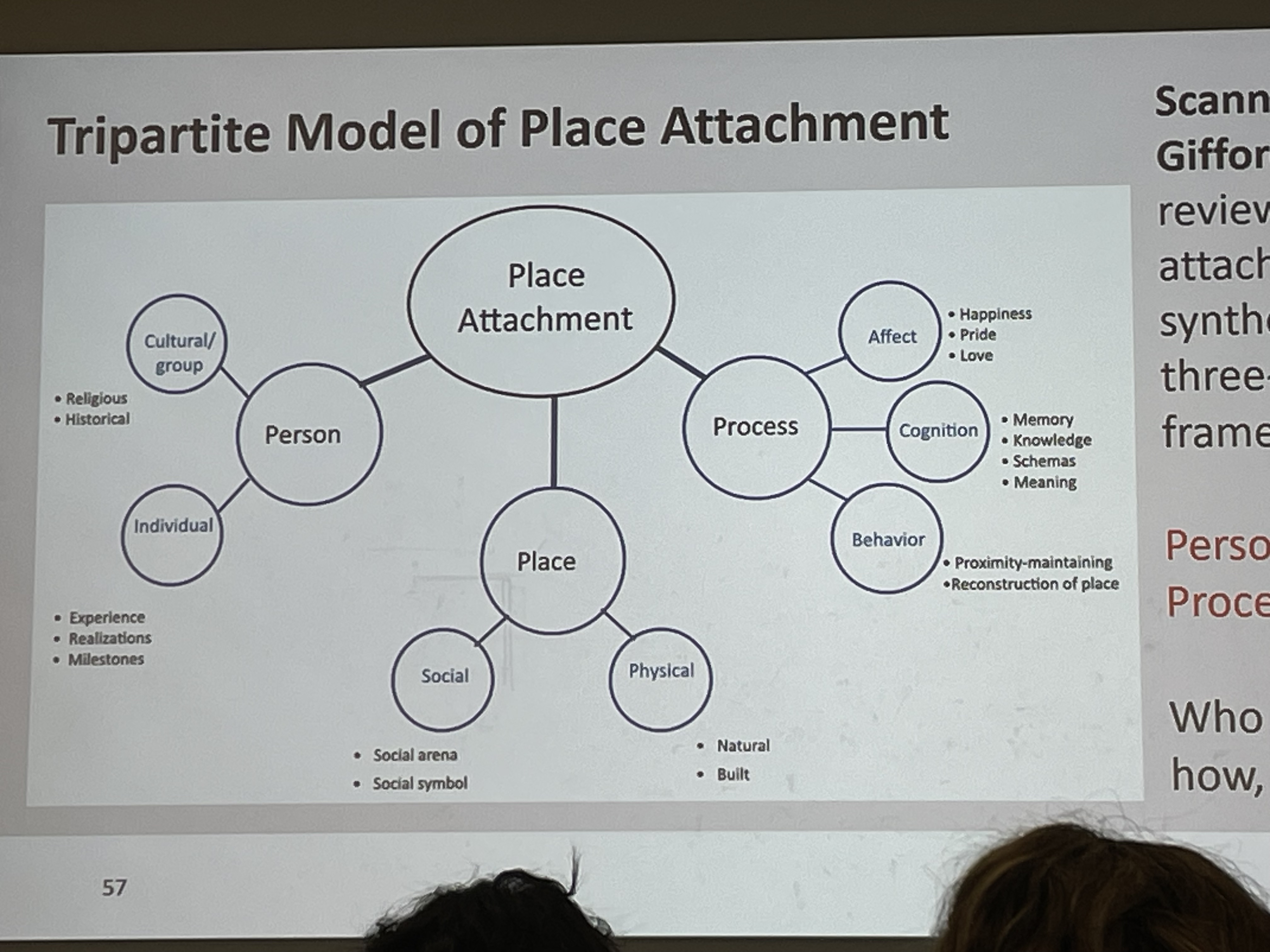
Tripartite model of place attachment
Emotion theories
Emotions theories:
- Happiness
- Sadeness
- Fearr
- Disgust
- Anger
- Surprise
Stimulus organism response theory
Complex relationship between humans and their environment can be captured in the stimulus-organism-response model
SOR model -> modifying factors
Experience sampling
ESM: Experience Sampling Method
Problems:
- People might not go to places they don't like; so we never have information about these places
Inclusive cities
Inclusion is about is about ensuring everybody can participat in dali ???