(W5) A Ladder Of Citizen Participation
(W5) A Ladder Of Citizen Participation
Participation is, in theory, the cornerstone of democracy.
Citizen participation is citizen power
Citizen participation is a categorical term for citizen power. It is the redistribution of power that enables the have-not citizens, presently excluded from the political and economic processes, to be deliberately included in the future.
Empty ritual versus benefit
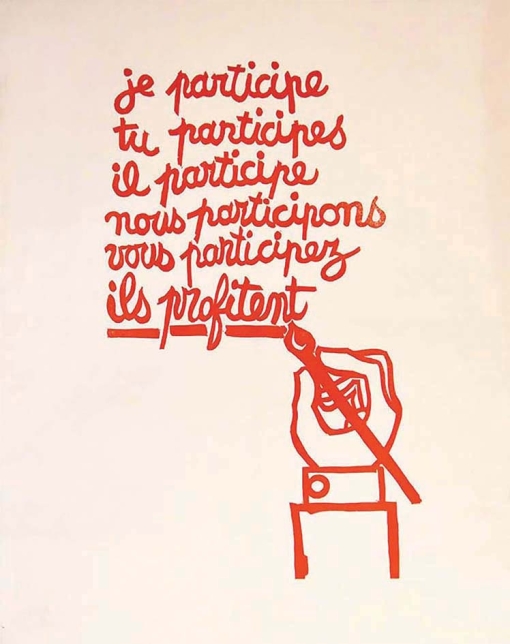
Participation without redistribution of power is an empty and frustrating process for the powerless.
Types of participation and non-participation
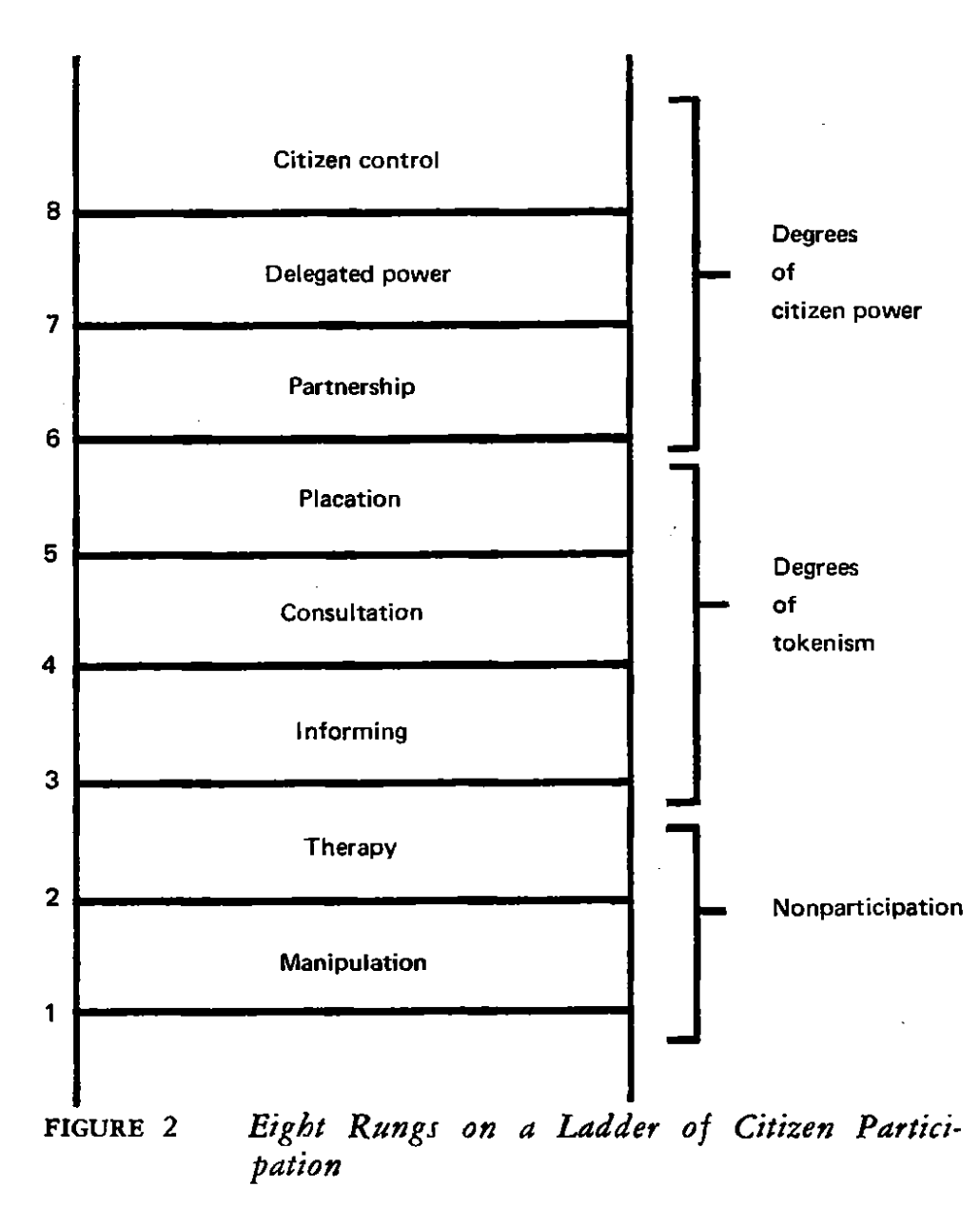
We can distinguish 8 levels of participation. They are ordered from less influence/power to more influence/power:
- [[#Manipulation]]
- [[#Therapy]]
- [[#Informing]]
- [[#Consultation]]
- [[#Placation]]
- [[#Partnership]]
- [[#Delegated power]]
- [[#Citizen control]]
Some are basically non-participation ([[#Manipulation]] and [[#Therapy]]): citizens don't really have any power, they are just being educated or cured by power-holders.
Some are considered levels of tokenism ([[#Informing]], [[#Consultation]], [[#Placation]]): have-nots (citizens, participants) are allowed to hear and be heard but they lack the power to ensure that their views will be taken into account.
Finally, we find levels that actually give power to the participants in the decision-making process ([[#Partnership]], [[#Delegated power]], [[#Citizen control]]).
They can all be arranged on a ladder, representing the amount of influence/power they have:
Manipulation
The participatory process has the "express" purpose of educating participants or engineering their support.
Therapy
The description in the paper makes no sense to me.
Informing
This is the process of informing citizens of their rights, responsibilities and options. According to the author, this is the most important first step towards legitimate citizen participation, but too often stays a one way process, where information only flows from officials to citizens and not the other way around.
Moreover, this steps often only comes at later stages of a given project, loosing much of the use it could have.
Consultation
In this process, people's ideas are heard, being an extra step over informing. This usually happens through attitude surveys, neighbourhoods meetings and public hearings.
Still, there is no assurance that the feedback will have any concrete impact on the project, risking consultation to be nothing more than a form of tokenism.
Placation
In this step, a select amount of people is included in decision boards, gaining, to some extent, some concrete decisional power. On the other hand, their votes risk being always overshadowed by the rest of the board.
Again, this method can be very efficient and just but also easily risks falling into mere tokenism, with the added benefit of making citizens feel more included in decision-making, even if they had no say at all.
Partnership
With partnership, we exit the level of tokenism and enter that of actual power.
Power is redistributed between citizens and power holders. This method is particularly effective if there is already some form of organised power-base community to which the citizen leaders are accountable. It might also require the citizens to hire technicians, lawyers and other professionals.
Delegated power
Sometimes the table can turn all together and the citizens may achieve the dominant decision making authority over a particular plan or program.
In this case, it's the power holders who have to start the bargaining process rather than respond to pressure from the other hand.
Citizen control
This is the last step of the ladder. Citizens have full control over a certain aspect of the city, or a project. They can manage funds and take decisions. In the end, this is unrealistic, since in practice some city authority always has to approve spendings and be responsible for the project.