03 - Responsible Research and Innovation - STRI
03 - Responsible Research and Innovation - STRI
Home readings
During this lecture the Responsible Research and Innovation Framework will be introduced and discussed.
- [[(W3) Developing a framework for responsible innovation]]
- [[(W3) Responsible Innovation and Responsible Research and Innovation - Owen & Pansera]]
- [[(W3) Reviewing responsible research and innovation - lessons for a sustainable innovation research agenda?]]
Lecture
by [[Johanna Höffken]]
It's a framework, a critique...
Outline:
- Brief recap and positioning
- Steering science and innovation - some basic thoughts
- The emergence of RRI in the EU context
- The RRI - AIRR framework
- A few deepening thoughts on RRI
Re-cap and positioning
We've talked about stability and change before. Today we are zooming in in this.
We will unpack the role of Research and Innovation. We also look at the question of responsibility.
Why should we look at responsible research and innovation?
It plays a huge role in bringing on change. One leverage for change is research and innovation.
- Are research and innovation processes and outcomes neutral? Can we steer them?
- Who is responsible for the processes and outcomes of research and innovation?
Steering science and innovation - some basic thoughts
Research and innovation play a crucial role in bringing about and directing change.
Science, technology and innovation in shaping our futures
Science and technology and innovations have the power to create futures and vulnerabilities.
It's important to acknowledge this.
What kind of future do we want to create with science and innovation? How can we engage collectively and inclusively as a society with these futures?
Science, technology and innovation are political artefacts
They are socially, environmentally, politically and ethically entangled.
Ivory tower of science: "Scientists feel like they are up there and want to keep politics out of their ivory tower". They try to keep objective and rational search for truth. Science advances only by essentially unpredictable steps, pursuing problems of its own.
A reason why science and technology should not be at the top of the ivory tower, is that they are today the engine of the market and darling of the knowledge economy.
Technoscience and innovation can have unintended consequences
They have uncertain and unpredictable impacts. Good intentions can have bad outcomes.
Examples:
- Social media and mental health
- Automation, AI and job replacement
- Geo-engineering
- E-waste
There are dangers on relying on a purely evidential and Consequentialist approach to science and technology.
[[Collingridge Dilemma]]
When a new technology is introduced (Technology Ideation), it is easy to control but very hard to know or predict its future implications.
As the technology becomes more establish (technology diffusion), its effects become more and more clear but it is also much harder to control it.
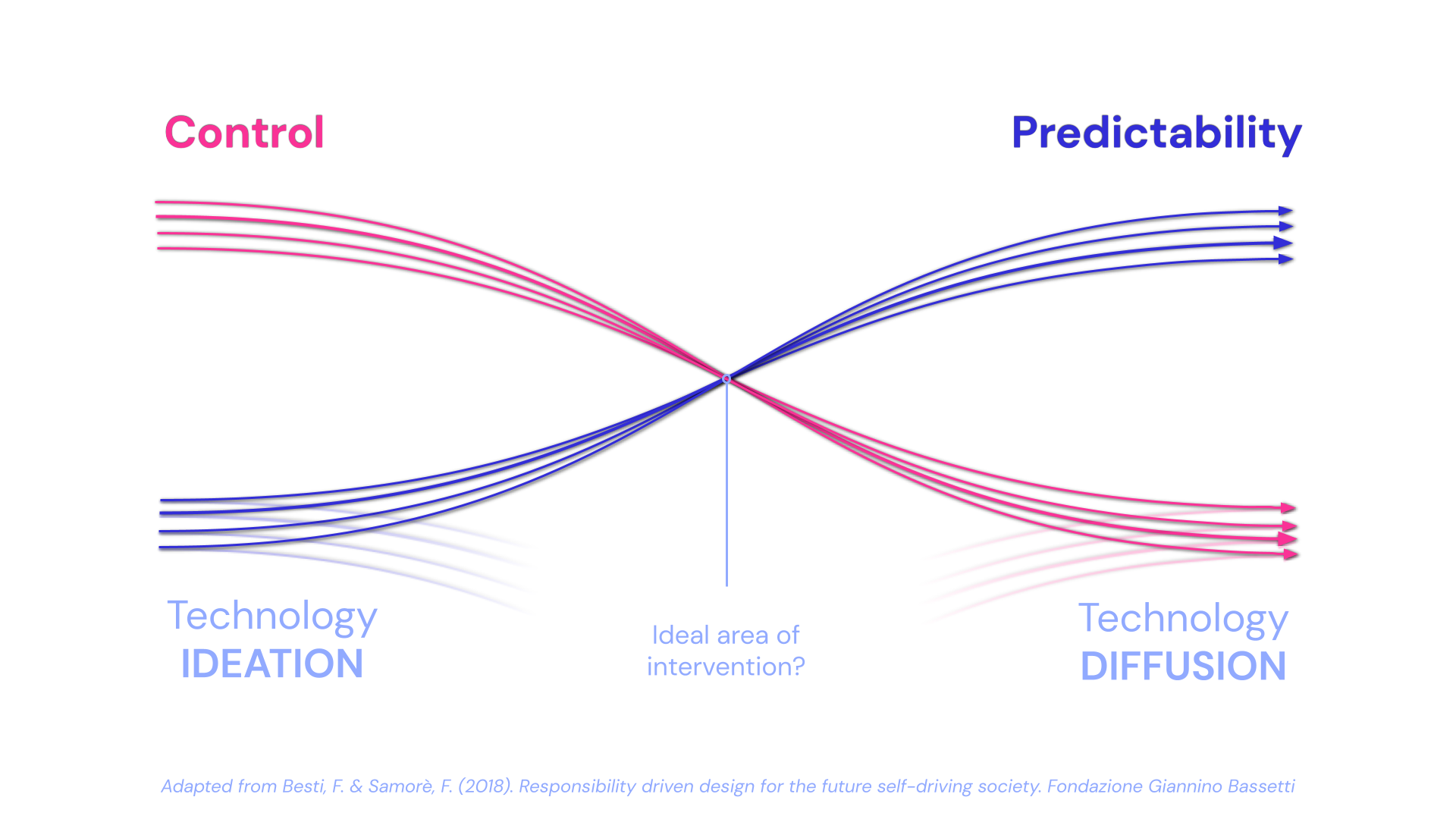
When change is easy, the need for it cannot be foreseen; when the need for change is apparent, change has become expensive, difficult and time consuming.
- Information problem
- Power problem
???
In early stages it's easy to change. Once the technology is developed, it's easy to loose control.
Consequentialist approach to science and innovation
Try so solve the problem when it comes up, not at the beginning.
Succumb to moral luck:
- Hoping that with the benefit of hindsight reasonable foreseeability cannot be proven
- Hoping not to be confronted by the legacy of own endeavours
Lines of accountability are not easily drawn between actions and consequences. This discounting of the future may appear attractive and pragmatic
It's morally troubling to do this:
- Undermines fairness for holding someone accountable
- Similar actions can be judged differently based on outcomes influenced by luck
- Can erode trust in the moral and legal system
Governance through the tenet of the market-choice
Market thinking is very keen in pushing science and technology.
Innovation implies the creation of value from ideas in a free-market economy.
Market is viewed as being best placed to direct goods and services to their most desirable end use.
Profitability as key criterion for market-driven innovation.
What happens to innovation which is deemed insufficiently profitable?
- Neglected
- Left to the state
- Or to philanthropy
There are other ways of innovation:
- Social innovation
- B corps movement
- Innovation aimed at the bottom of the pyramid
Aim to combine innovation as a profit-driven, competitive, market-based activity with the co-production of social goods.
The emergence of RRI in the EU context
European Commission (EC) (not elected by us). It has the right to propose new laws and regulations...
A content of the EC is Research and Innovation.
According to EU:
RRI It's an approach that anticipates and assesses potential implications and societal expectations with regard to research and innovation, with the aim to foster the design of inclusive and sustainable research and innovation.
It's into a funding program.
RRI is a cross-cutting policy: it goes into a lot of fields. Examples:
- promoting science communication
- open access
- gender equality in science
- ethical dimension
- ...
RRI is the end product of several decades of social science and humanities research in the broad areas of:
- Science and communication
- public engagement
- technology assessment
- and user led design
RRI builds on traditions such as science technology studies and ethics of technology
RRI builds on technology assessment (TA)
ELSA: Ethical, Legal and Social Aspects
It combines many different strands in the social sciences.
There are a ton of different approaches, form different people on how to approach RRI. You can se it for:
- Articulation
- Interpretation
- Assessment
- Intervention
Responsible research and innovation
It aims to tackle the problems of steering research and innovation.
RRI is a future-oriented approach. It allows for:
- Greater potential to accomodate uncertainty
- Reflection on purpose and values
Shift to collective responsibility:
- From individual, consequentialist responsibility
- To collective process - and outcome - oriented responsibility
Responsibility as responsible process and responsible outcome.
We also look at the process of how we innovate.
this means engaging more people:
- Policy makers
- research community
- education community
- business
Responsible Research and Innovation is a transparent, interactive process by which societal actors and innovators become mutually responsive to each other with a view to the (ethical) acceptability, sustainability and societal desirability of the innovation process and its marketable products (in order to allow a proper embedding of scientific and technological advances in our society).
(Von Schomberg, 2012, p. 50)
It's based on perspective notion.
The AIRR framework
The 4 AIRR dimensions
AIRR: it has 4 dimensions.
It's a framework for doing RRI.
- [[#Anticipation]]
- [[#Reflexivity]]
- [[#Inclusion]]
- [[#Responsiveness]]
Anticipation
Asking WHAT IF? questions. Aimed at increasing resilience.
Reflexivity
- Holding a mirror up to one's own activities, commitments and assumptions.
- Recognizing limits of knowledge.
- Particular framing may not be held universally.
Inclusion
Inclusions of new voices. It's about engagement. hear more voices, in the search of legitimacy.
Enable public debate to take place upstream in the scientific and technological process.
Responsiveness
Respond:
- to react and to answer
Capacity to change shape or direction in response to stakeholder and public values and changing circumstances.
A few deepening thoughts on RRI
RRI looks not so much at the structure. It puts a lot of focus on innovators. It emphasises the role of individuals.
Change within the system, not of the system
It's change WITHIN the system, not OF the system.
DOn't need to change the institutional context in which innovations are pursued.
CRITIQUE:
- RRI might have rather conformist nature
- RRI approaches see responsibility as subservient to economic growth and industrial success
Responsiveness: agenda setting
We've said [[#Responsiveness]] should not only be about changing circumstances but also in terms of setting and framing of the policy agendas and challenges technoscience and innovation should address.
Focus on governance of intent is contested. Challenges principles of market governance and scientific autonomy.
Should we control or keep free.