(W6) - Justice in Energy Transitions
(W6) - Justice in Energy Transitions
Introduction
According to the authors:
Justice is the fair, equitable and respectful treatment of humans, other species and the environment.
Literature review
Divided in 3 sections:
- [[#Transitions]]
- [[#Environmental Justice]]
- [[#Energy Justice]]
Transitions
A sustainable energy transition is defined as "major change in buildings, energy and transport systems that substantially enhance energy efficiency, reduce demand or entail a shift from fossil fuels to renewable inputs. These system transitions entail not only technical changes, but also changes in consumer behaviour, markets, institutions, infrastrcuture, business models and cultural discourses".
Transitions as a field of research focus on the trajectory of change.
The authors also highlight the importance of governance research because it contributes to understanding the historical contextualisation of transitions. It emphasises the embedded patterns, actions and structures, and how changes within these domains are influenced by exogenous trends.
They propose several approaches. One is the "Legal Geography JUST framework" by Heffron and McCauley, 2018, p.77.
| Field | |
|---|---|
| Justice | Distributional, procedural or restorative justice |
| Universal | Recognition or cosmopolitan |
| Space | Locaiton, where are events happening |
| Time | Time, when are events happening: timeline |
Some scholars argue that transitions should be studied as a process, not as an end point.
Environmental Justice
Environmental justice is defined by the authors as the fair treatment and meaningful involvment of all people regardless of race, color, national origin, or income, with respect to the development, implementation, and enforcement of environmental laws, regulations, and policies.
The principle is that disadvantaged communities should not be subject to disproportionate environmental impacts.
Scholars identify 3 concept of justice
- Distributive justice: distribution of goods
- Who are the recipients of environmental justice
- What is to be distributed
- What is the principle of distribution
- Procedural justice: the way decisions are made, who is involved
- Inclusion and exclusion in decision-making processes around environmental and social issues
- Justice as recognition: who is given respect and who is and isn't valued
Climate justice is focused on assisting those affected by the impacts of climate change, sharing the burden and mitigation and adaptation
Energy Justice
Energy justice is defined as a global energy system that fairly distributes both the benefits and burdens of energy services, and one that contributes to more representative and inclusive energy decision making.
A true energy system transition requires thinking and operating differently, where in addition to new technology, decision making processes need to be proactive and collaborative.
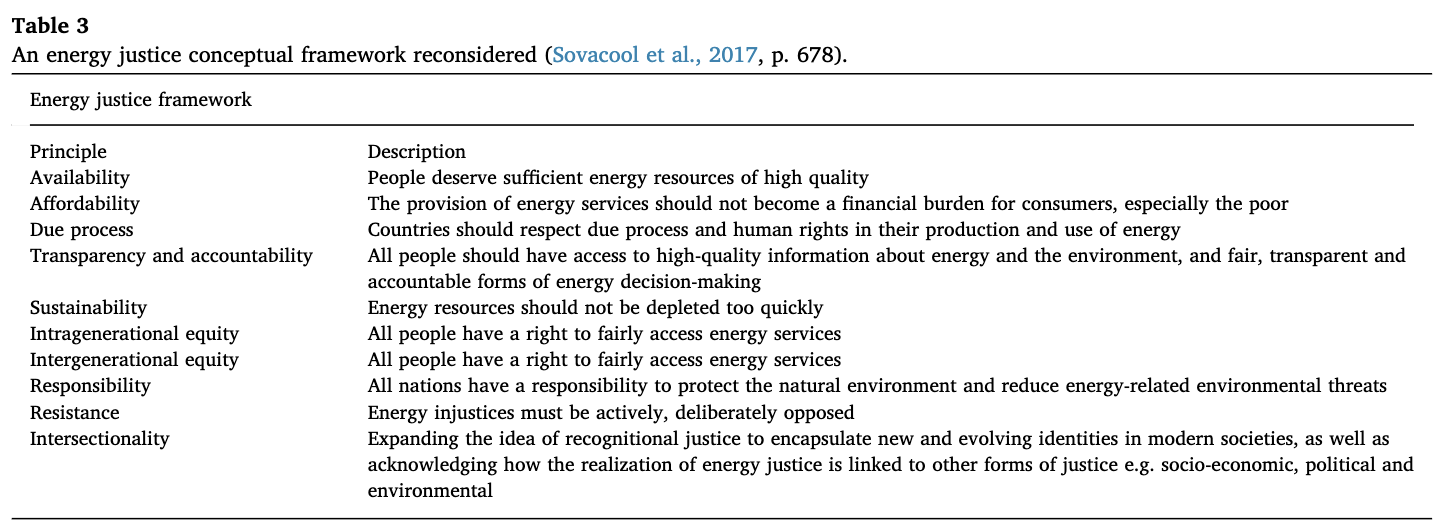
A possible framework for energy justice:
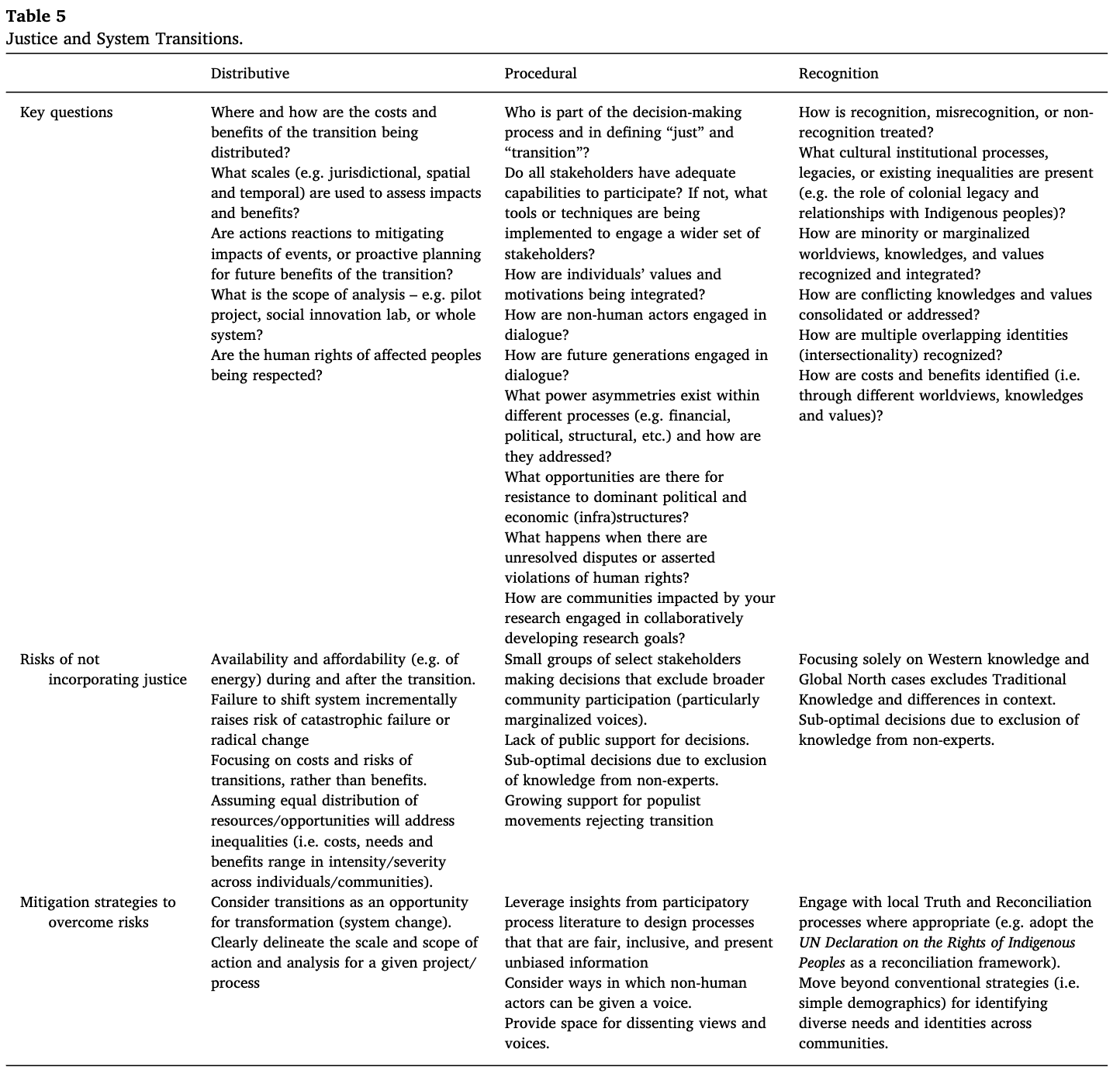
Analytical framework - addressing justice
Based on the literature review, the authors developed a set of questions to be addressed when discussing justice in energy transitions. They are summarised in the next figure: