05 - Modal Split and Random Utility Model - TDBM
05 - Modal Split and Random Utility Model - TDBM
Modal split is the second step in the modeling stage of the classic 4 stage framework.
In terms of an O/D matrix like the following, in this step we basically take the matrix, and from that we get 2 ore more (depending on how many option we are looking at).
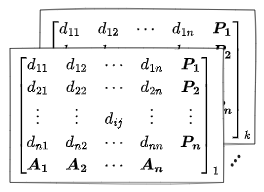
%%🖋 Edit in Excalidraw%%
where:
number of trips from TAZ to TAZ tot number of trips generated by TAZ - It's the sum of the colums
tot number of trips attracted by TAZ - It's the sum of the rows
tot number of TAZs the mode of transportation
Along this note, the number of trips from TAZ
Factors affecting modal split
There are many factors affecting modal choice, some related to passengers (aka characteristics), some to the trip and lastly some variables considered as averages.
| Passenger | Trip | Mean |
|---|---|---|
| Vehicle availability | Purpose | Waiting time |
| Income | Hour of the day | Travel time |
| Family structure | Cost | |
| Housing density | Cost and parking facility | |
| Constraints of the rest of the day | Comfort | |
| Regularity | ||
| Safety |
Discrete choice models
Modal split models are based on utility theory. The general principle is that the trip maker tries to maximize the UTILITY.
Utility is a function that is split into two parts:
where:
the transport modes the perceived utility the [[#measurable utility]]. Deterministic the random part of the utility
Each passenger chooses mode
Given that there is a random part to each utility, it is possible that 2 modes which deterministic utilities are ordered as:
in the end have a perceived utility
due to the random part.
Measurable utility
The measurable utility is a linear combination of attributes:
where:
are the parameters to calibrate are the attributes
The parameters are calibrated through the method of maximum likelihood (method of maximum likelihood.
Random utility
The random part of the utility,
We can prove that:
Probit model
The Probit model is particularly useful as it can accomodate for routes that share part of the links.
Logit model
The Logit model is not able to accomodate for routes that share part of the links. In probabilistic terms:
(i.i.d.: indipendent and identically distributed)
The probability of mode
Nested logit models
The part that follows was written by ChatGPT. I have read it all and it makes sense to me BUT I have used it in place of the slides (since those are terrible and impossible to follow). This mean that I did not get the information from the slides themselves or from any book for that matter.
My understanding of this tipic realies moslty on an explenation provided by Large Language Model and might be inaccurate.
I'd like to add that I hate doing this, as I prefer writing these notes myself and from reliable information but again, the sources I had available were incomprehensible to me I had to choose between understanding something with an unkwon probability of it being correct vs the certeinty of not understanding anything. I chose the first, but I invite anyone reading this to keep this in mind.
🧠 Context
In transportation demand modeling, a modal split model predicts how travelers choose between transport modes (e.g., car, bus, train, bike). This is modeled using discrete choice theory, where each individual picks the alternative that gives them the highest utility.
The classic model is the Multinomial Logit (MNL) model, which assumes:
- Perfect substitution between all alternatives.
- Independence of Irrelevant Alternatives (IIA) — the ratio of probabilities of choosing two modes does not change if a third one is added or removed.
This is unrealistic when some alternatives are similar" (e.g., bus and train are both public transport), because MNL cannot capture correlation in unobserved factors.
❗ Problem with MNL:
Choosing between car, bus, and train treats bus and train as equally different from car as they are from each other — which is often wrong.
🚦 Solution: Nested Logit Model (NL)
The Nested Logit (NL) model generalizes MNL by allowing for correlation among similar alternatives, while still being computationally tractable.
🌲 Nesting Structure
Imagine the traveler faces this decision tree:
          Travel Mode
         /           \
    Private        Public Transport
     /   \             /      \
   Car  Moto        Bus     Train
Alternatives are grouped into nests based on similarity (e.g., Bus and Train are both PT, and may share unobserved characteristics like comfort or exposure to traffic).
📐 Utility Specification
Each individual
Where:
: Total utility of alternative for individual : Systematic (observed) part of the utility (e.g., cost, time, income effects) : Random (unobserved) part
🪜 Nesting and Probabilities
Let's define:
: the full choice set (e.g., all travel modes) : set of nests (branches), e.g., : alternative belongs to nest
The probability of choosing alternative
Step 1: Inclusive Value (Logsum)
For each nest
Where:
nesting parameter, measuring the degree of independence within the nest: full independence (ie, back to MNL) correlation within nest
Step 2: Probability of Nest and Alternative
(a) Probability of choosing nest
(b) Probability of choosing alternative
🔄 Final Choice Probability:
🔧 Parameters and Interpretation
(dissimilarity parameter) must lie in : : the nest behaves like an MNL (no correlation). - Closer to 0: stronger correlation among alternatives in the nest.
- Different
for each nest allows modeling different levels of similarity.
✅ Why Use Nested Logit?
| Feature | MNL | Nested Logit |
|---|---|---|
| Correlated alternatives? | ❌ No | ✅ Yes (within nests) |
| IIA assumption? | ✅ Yes | 🚫 Only within nests |
| Flexible substitution patterns? | ❌ No | ✅ Yes |
| Complexity | ⭐ Simple | ⚠️ Moderate (more parameters) |
🧪 Example: Mode Choice
| Nest | Alternatives |
|---|---|
| Private | Car, Motorcycle |
| Public | Bus, Metro, Tram |
Suppose
📉 Estimation
- Usually done via Maximum Likelihood Estimation (MLE)
- Requires choosing a nesting structure (tree) and estimating:
- Coefficients in
for each nest
- Coefficients in
❗ Caveats
must satisfy a consistency condition: - The model is still additive random utility:
follow a Generalized Extreme Value (GEV) distribution - Incorrect nesting can lead to biased results
🔚 Summary
- Nested logit extends MNL to allow for similarity between alternatives.
- It uses a hierarchical structure: choose nest, then alternative.
- Key concepts:
- Inclusive Value
- Dissimilarity parameter
- Improves realism, especially for modal split modeling in transport.
📚 9. Summary Table
Here we are using
For individual
| Concept | Symbol / Formula | Description |
|---|---|---|
| Utility | Total utility | |
| Deterministic utility | Observed utility part | |
| Inclusive value | Utility of a nest | |
| Nest prob. | Nest selection | |
| Conditional prob. | Alternative within nest | |
| Overall prob. | Final choice prob. | |
| Nesting parameter | Measures correlation within nest |
Nested logit models - Degenerative branches
A degenerative branch (or degenerate nest) is a nest that contains only one alternative.
This is important because:
- The whole point of nesting is to model correlations between alternatives.
- If a nest has only one alternative, there is no correlation to capture.
- It can also create identification issues if not handled carefully.
⚖️ 2. Are these two nesting structures equivalent?
Let's compare your two examples:
Case 1:
- Nest A: Private vehicles
- Nest B: Public transport → Bus, Train
(Private vehicles is treated as a single alternative, not a nest with branches)
Case 2:
- Nest A: Private vehicles → Car
- Nest B: Public transport → Bus, Train
(Private vehicles is now a nest with only one alternative: Car)
🔍 Are they equivalent?
Yes, in practice they are equivalent, because nest A in case 2 is degenerate: it contains only one alternative.
This means:
- The inclusive value for the nest A becomes trivial (you’ll see below).
- The nesting structure adds no behavioral value for that single-alternative nest.
Hence, if a nest has just one alternative (like "Car" in "Private"), it collapses to a standard logit model for that alternative.
But! There is a subtle technical difference in the way you write the equations and estimate the model, as we'll now see.
📐 3. Relevant Equations for Private Vehicle Branch (Degenerate Nest)
Suppose:
is the full choice set: - The nesting structure is:
        Mode Choice
             |
    --------------------
    |                  |
  Private            Public
   Car         -----------------
              |               |
            Bus            Train
Let’s write the overall probability of choosing Car.
🚘 Car (in a degenerate nest):
- Since Car is the only alternative in its nest, the within-nest probability is 1:
- The inclusive value for nest A (Private) is:
- The nest probability becomes:
- So the overall probability of choosing Car is:
This is effectively just an MNL-style logit formula comparing:
- The raw utility of car
, and - The logsum utility of public transport.
🚍 What about Bus and Train?
You still use the full nested logit formula:
- Inclusive Value of Public nest:
- Probability of Public nest:
- Conditional probabilities:
- Final probabilities:
🚧 4. Practical Considerations
Estimation:
- A degenerative nest does not cause computational issues if treated correctly.
- However, the nesting parameter
becomes non-identifiable if there's only one alternative — it's often set to 1 or the nest is simply not modeled.
Interpretation:
- There's no value in creating a nest with one alternative unless:
- You plan to add more modes later (e.g., motorcycle).
- You want a symmetric structure for clarity.
✅ 5. Conclusion
| Feature | Case 1 | Case 2 |
|---|---|---|
| Private vehicles | One alternative (Car) | Degenerate nest (Car only) |
| Structural effect | Same behavioral result | Same, unless extended |
| Modeling implication | No need to nest Car | Nest adds complexity without gain |
| Estimation issue | None |
Takeaway: Don't create degenerate nests unless you need structural symmetry or plan to expand the model.