02 - Institutional Entrepreneurship - STRI
02 - Institutional Entrepreneurship - STRI
Home readings
In this lecture, we will discuss the concept of institutional entrepreneurship using both Multilevel Perspective (MLP) and the Strategic Niche Management (SNM) framework, highlighting actors’ agency in changing rules to effectuate regime change for sustainability. It is therefore important that you know what MLP and SNM are before you come to this lecture. You can update your knowledge on these two frameworks by reading the pre-knowledge literature.
- (W2) Institutional Entrepreneurship as Embedded Agency - An Introduction to the Special Issue
- (W2) NESTwebinar 8 - Institutions in Transitions - Lea Fünfschilling
- (W2) An institutional perspective on sustainability transitions
Lecture
Socio-technical systems
Theories:
3 theories to get to the full understanding on the topic:
- [[#Structuration theory]] (Giddens, 1984)
- [[#Sociology of technology]] (Bijker and Law, 1992)
- [[#Institutional theory]] (a.o. North, 1991)
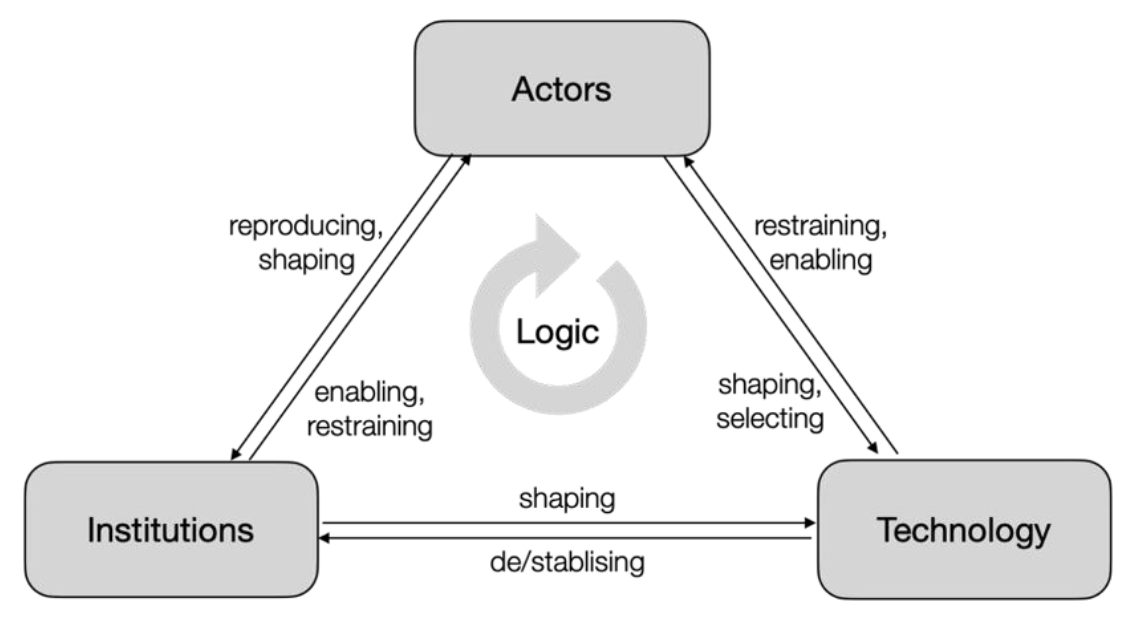
Structuration theory
We as actors, set certain structures, that both contstrain our activities but also make things possible. There is a duality of this structure.
One drawback of the structuration theory is that it does not make any connection to materiality, to infrastructure
- [?] What does this mean?
Sociology of technology
It talks about how these structures are embedded in the "infrastructure" we live in.
Institutional theory
It helps the notion of institutional context. It helps understand how institutions interact with the social structure.
- Rules
- Institution
- Institutionalization
- Institutional ???
Rules
Rules are organizing and coordinating features that coordinate our life. They guide the behavior of the actors. They lead to a regular pattern of practice.
3 different types of rules:
- Regulative (ex. speed limits, no killing)
- Normative (ex. Give up seat on the bus to elderly people, no standing in front the exit of a train when people are alighting)
- Cognitive (ex. people getting in line/queues, elderly people are in principle wise)
If rules are socially embedded and are accepted and aligned, they become [[#Institution]]:
Institution
A set of socially embedded and accepted systems of [[#Rules]].
- Institutions are created and reproduced by actors but can also be constraining (duality)
- Institutions are material and symbolic
- Institutions are historically contingent (history matters)
- Institutions can be analyzed at various levels ( individual, organizational, societal)
Insitutionalization
for an [[#Institution]] to exist, there should be a process of institutionalization
- Institutionalization
- Homogenization & increasing compatibility with external environment (Di Maggio & Powell, 1983)
- Embedding & expressing rules & the way they are widely diffused & adopted by broad section of society
- Forms
- Normative pressures - professional expectations, methods of work
- Coercive isomorphism - formal & informal pressures exerted by societal expectations, brought by government mandates & regulations
- ex: In Asia there is a lot of production for western market. They would probably do things in a different ways but the global market has different expectations
- Mimicry - imitating or copying of others who are successful to eliminate uncertainty & reduce complexity
- It pays to be like the crowd. We behave differently whether we are alone or in groups
Implications:
- Actors rewarded for their resemblance to other due to benefits: legitimacy, respectability, political power
- Incumbents – no motivation to change
- Entrants (when trying to do things differently) find high barriers
Process of institutionalization

there is some sort of novelty:
It starts with a fase of habitualization:
- Few actors, uncoordinated activities
- No consensus on theory
With a lot of institutional work, then there is a process of objectification:
- There starts to be consenus, more agreement
- Variance between opinions change
Finally, there can be the fase of sedimentation. This implies the complete diffusion of the novelty.
- Normative process starts to happen.
- There is quite a low resistance
De-institutionalizaition is simply the inverse process of what is described here. If we want to get into a new system, we go from sedimentation to a new novelty

All that happens in our lives is evolutionary: all of us, as individuals or as groups, we engage in life in certain ways and to some extent we purposely push things in a certain directions and to some extent we do not.
Institutional logic
Wwe apply it to socio-technical systems.
Sets of rules embedded in actors and technologies. All 3 interact with each other
Actors, institutions and technology are all connected by some principles.
Regimes
Dominant, higly institutionalized socio-technical structures, subject to constant negotiation between strategic actors.
- [?] Difference between [[#Regimes]] and [[#Institution]] and [[#Institutional logic]]?
Institutional complexity
- Actors exposed to many different institutions, contexts, institutional demands
- Due to varying geographies, levels, industries, professions, fields
- When interpretation of rules starts to diverge, actors disagree on shared ideas, preferences -> space for:
- Creativity & conflicts over meaning, application, enforcement
- Alteration, reinterpretation, repurposing of rules
- Agency, innovation & change (Greenwood et al., 2011)
- Theoretically this:
- Reveals the dynamics in the regime: tensions, disintegration, destabilization
- Makes regimes just like niches a potential source of change
each institutional order has its own sense of rationality, main emphasis has been to privilege continuity and constraint in social structure.
however, strategic behavior fundamentally relates to the capacity of the individuals and organizations to conceptualize and act upon alternative views of rationality
De-institutionalisation
The process of de-legimizing an existing [[#Institution]].
ex: delegitimise fossil fuels.
Entrepreneurship
Creative destructure: it's about dismantling the institutionalised way of doing things.
Institutional entrepreneurship
It's a paradox:
- [[#Institution]] is about keeping things as they are
- [[#Entrepreneurship]] is about changing things
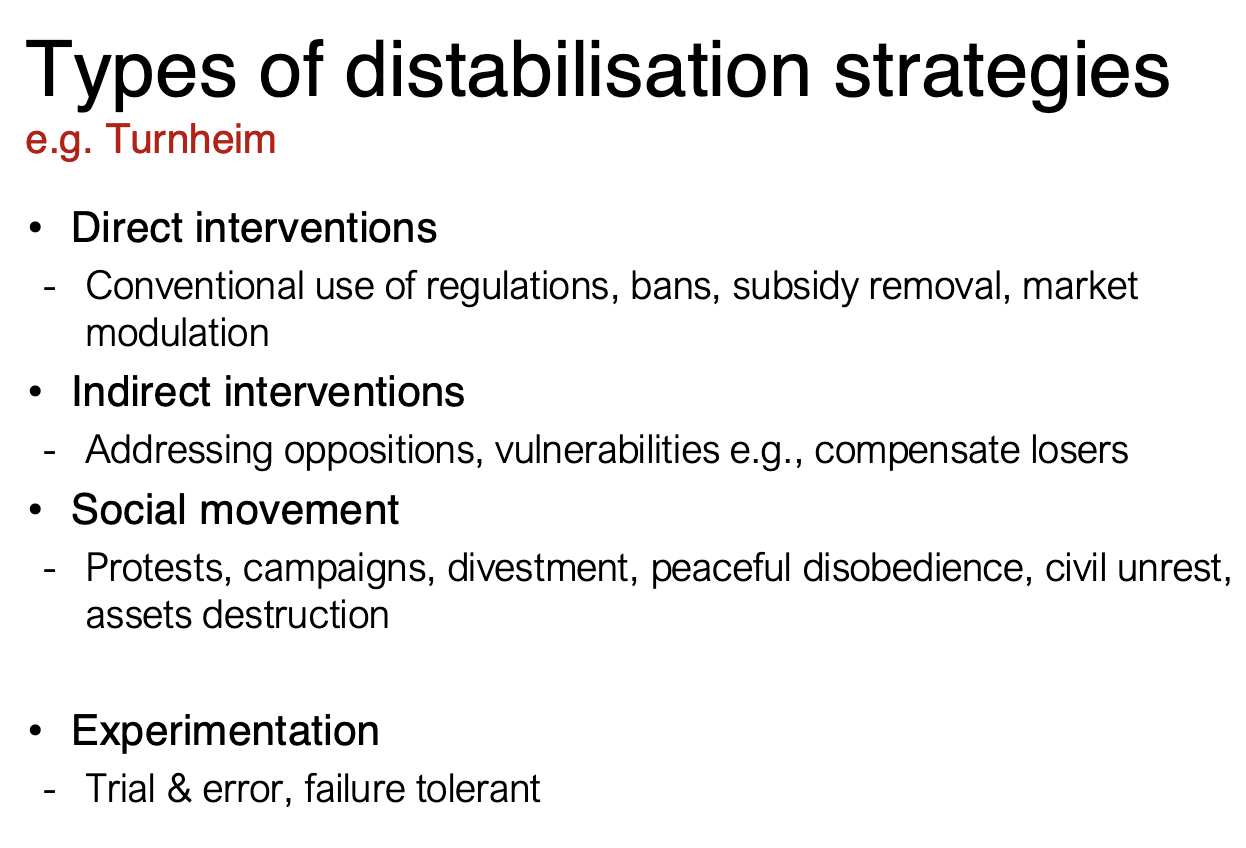
Destabilisation strategies
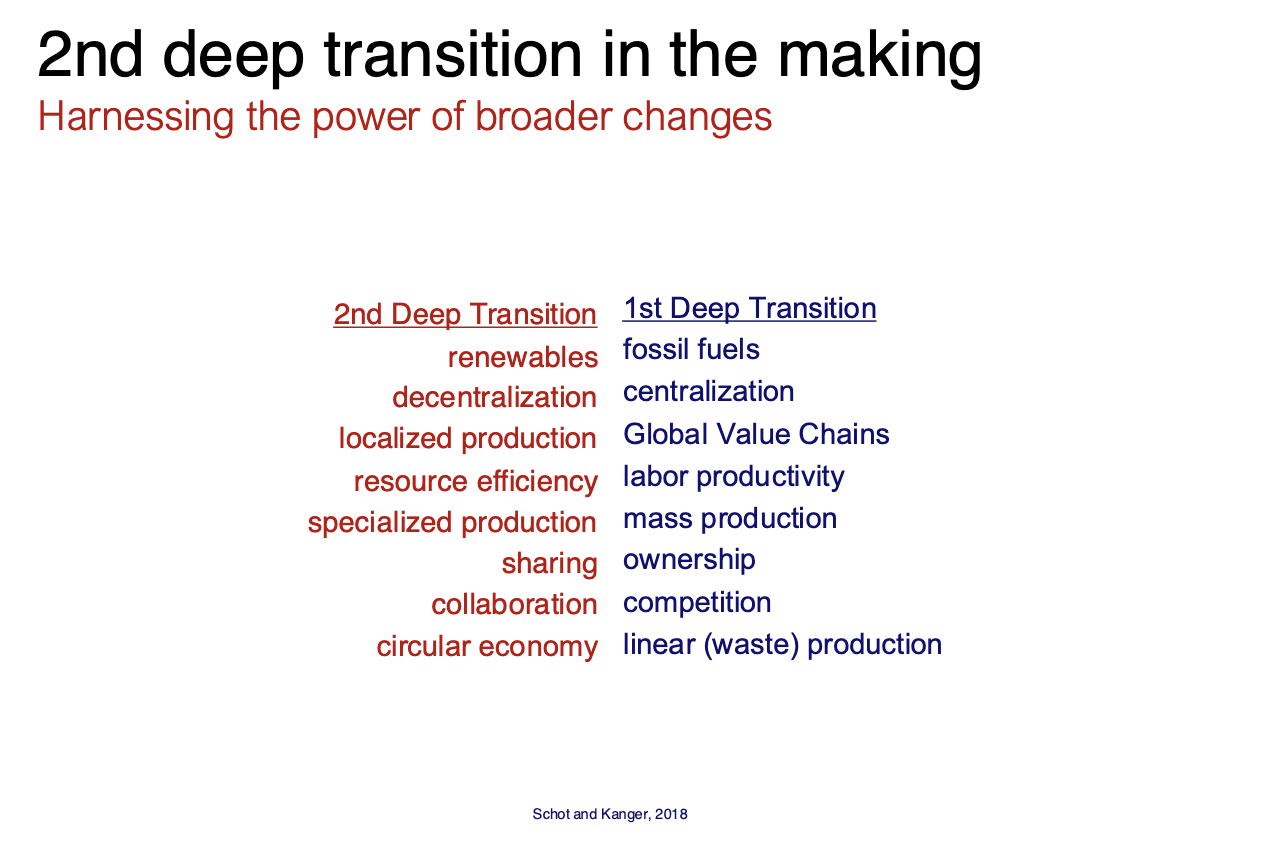
We are in a 2nd deep transition. It's different than a 1st deep transition.
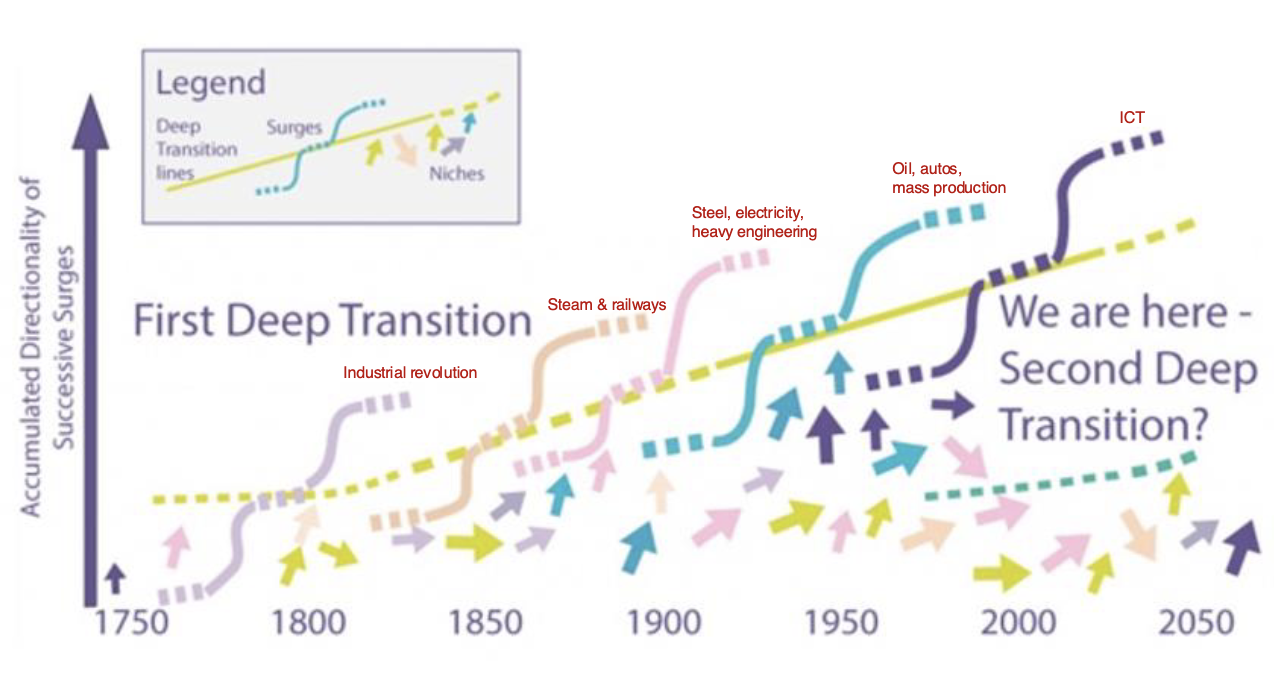
We can either keep the same development process, or go down to a second deep transition and do things completely different.