01 - Intro - STRI
01 - Intro - STRI
Home Readings
-
Elzen and Wieczorek, 2005 on general transitions: Elzen, Boelie & Wieczorek, Anna J. (2005). Transitions towards sustainability through system innovation. Technological Forecasting and Social Change, 72(6 SPEC. ISS.), 651-661.
-
Geels, 2002 on MLP: Geels, F.W. 2002. Technological transitions as evolutionary reconfiguration processes: a multi-level perspective and a case study. Research Policy 31(8/9): 1257–74
-
Kemp et al, 1998 on SNM: Kemp, R., J. Schot, and R. Hoogma. 1998. Regime shifts to sustainability through processes of niche formation: the approach of strategic niche management. Technology Analysis and Strategic Management 10, (2): 175–96.
-
Loorbach et al, 2017, Sustainability Transitions Research: Transforming Science and Practice for Societal Change, Annual Review of Environment and Resources, Vol. 42:599-626.
-
bo van de Poel and Lambèr Royakkers (2011). Ethics, Technology, and Engineering: An Introduction, First Edition. Published by Blackwell Publishing Ltd.
Lecture
Uncertainty of emergent technologies
Social contruction of technology
Technology
Is technology enough to solve problems?
- We need technology
- We also need behavioural change
- Society is giving meaning to technology
Every technology implementation brings with it [[#Dilemmas]]
Dilemmas
Every [[#Technology]] implementation brings with it dilemmas.
For example, we are collecting huge quantities of data. What if the data is leaked?
There are risks associated with implementing new technologies, which raises the question: what are the implications of using new technologies?
Technological innovation
Technological innovation can be transformative, beneficial and changing the world. But it is also full of risks, controversies, ethical dilemmas and higly uncertain.
Societal challenges
Societal challenges are problems that is experienced by a bigger part of society.
The common denominator is that they are:
- complex: a lot of interrelations between actors and elements
- nonlinear:
- uncertain:
- value-laden:
- Not every one perceive these challenges as challenges
- locally conceived, globally manifested
Therefore, there is a necessity to talk to people, to be in a dialogue. If we consult people about their problems, there is a chance that we can come up with a better solution.
Up to now, we've been saying that innovation is needed for economic growth. Now we realise that we did it at the cost of our environment.
What is the goal of innovation? Do we solely innovate for economic growth? Also for sustainability?
SOCIO-TECHNICAL EXPERIMENTATION:
Testing the proposal in a village, with real people. Testing things out in real life.
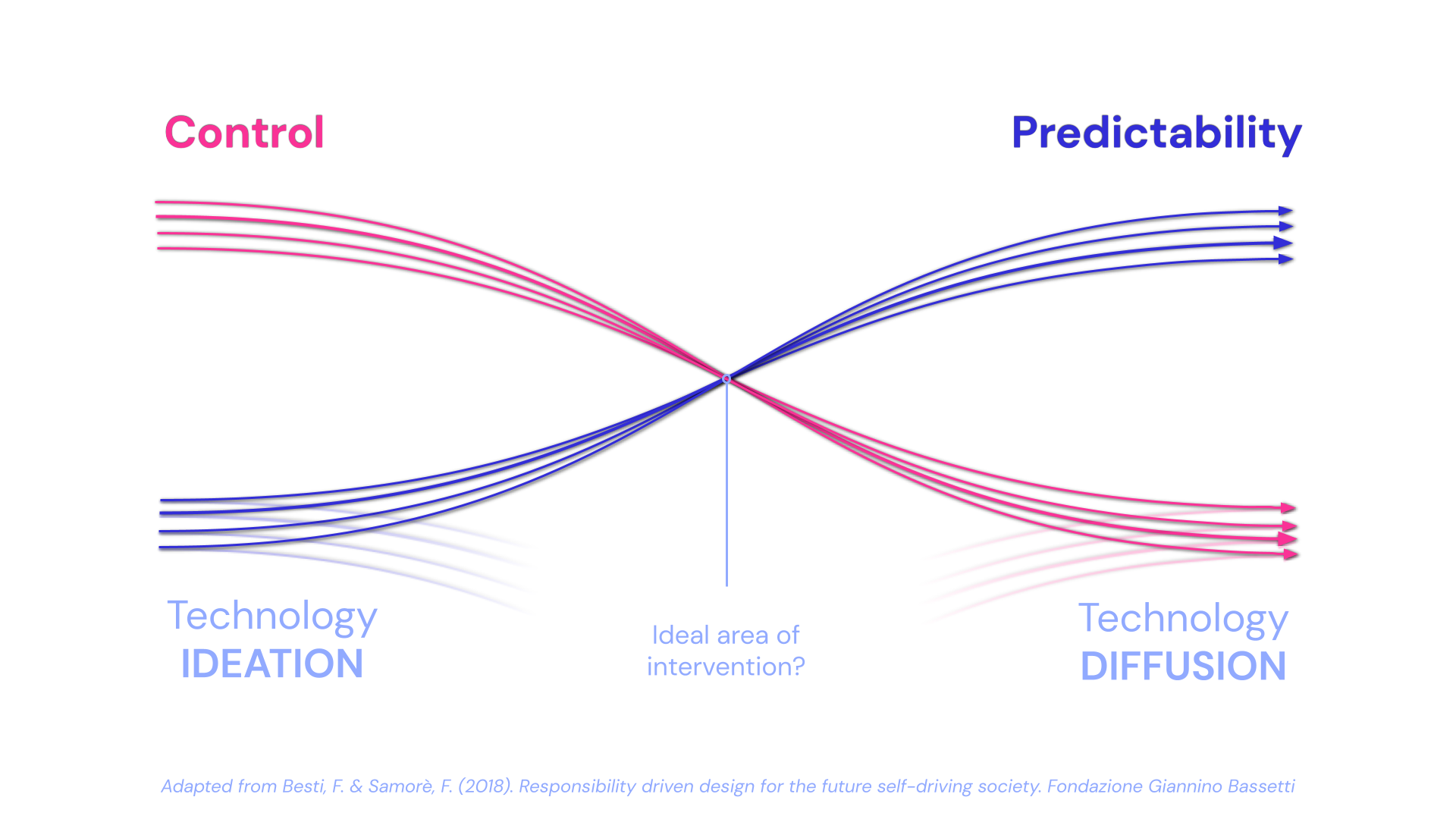
[[Collingridge Dilemma]]
When a new technology is introduced (Technology Ideation), it is easy to control but very hard to know or predict its future implications.
As the technology becomes more establish (technology diffusion), its effects become more and more clear but it is also much harder to control it.
Sustainability Transitions
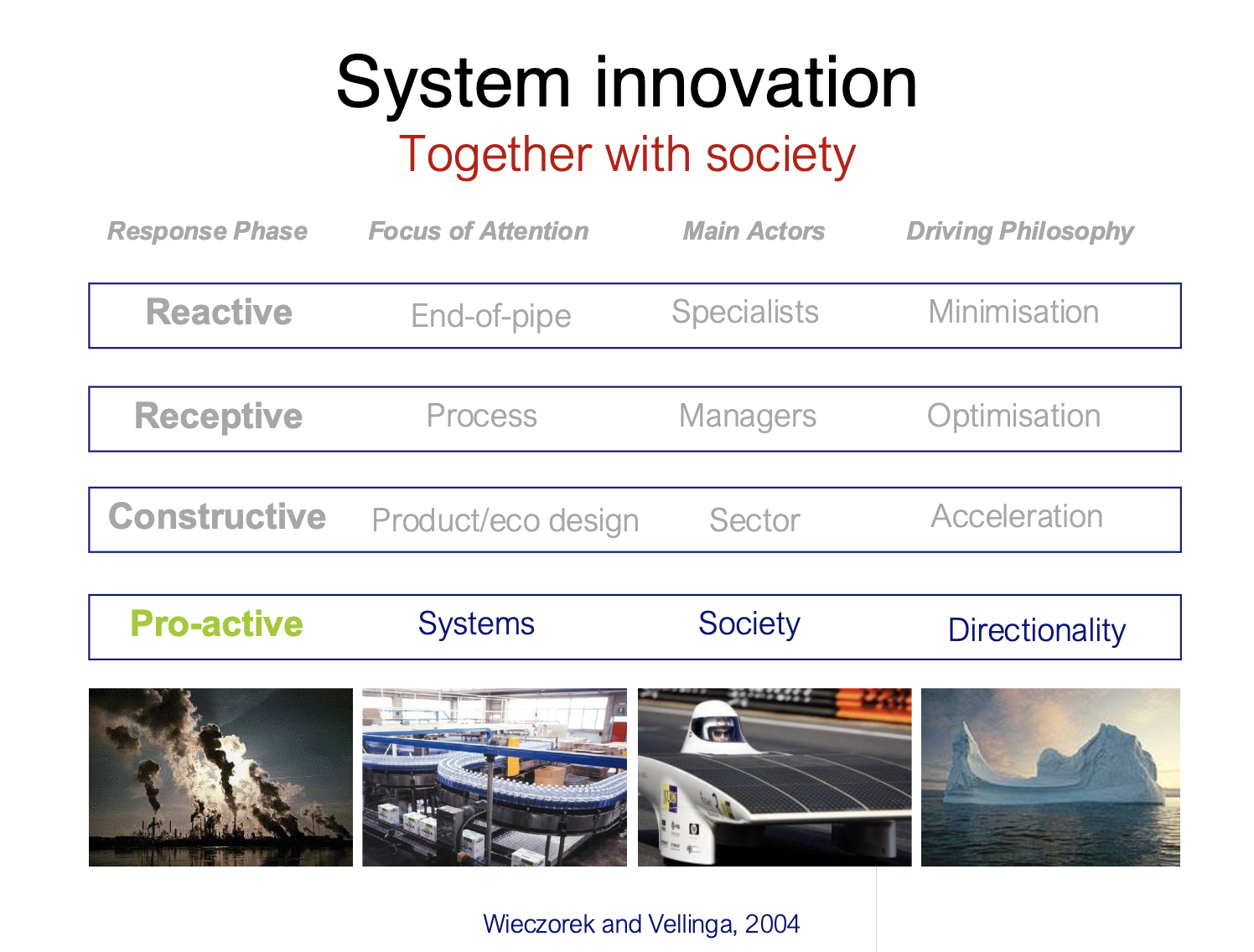
System Innovation
Sustainability transition
System change is often called a transition.
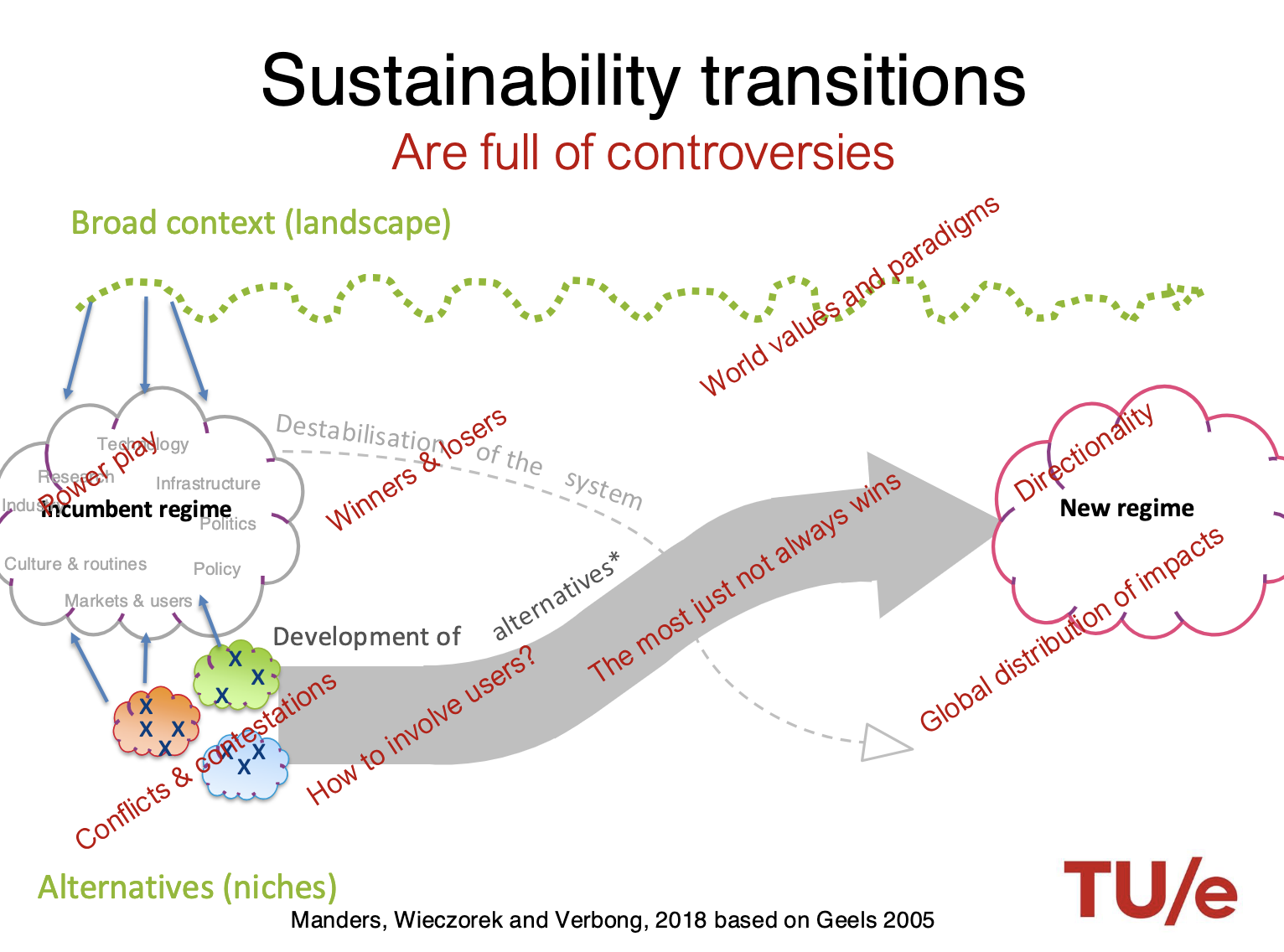
Sustainability transition is the process of going from the status quo (Incumbent regime) to a new regime where we can keep functioning
Broad context (landscape) --> these are the big trends/developments/shocks (war, price change on oil...): they often provide opportunities, making space for new alternatives that can allow for a new regime.
In the incumbent regime:
- Power play
- Conflicts and contestations
How do we involve users?
Not always the best solutions wins. What wins is the solution that has the most votes.
There are always winners and losers
Strategic Niche Management
How do we support niches?
- Shielding
- Nurturing
- Feed the niche. Make sure that a lot of people like it and use it
- Empowering
- How do you navigate your way in a system that works in a completely different way
System vs regime
Regime is a logic.
A practice that is embedded into us.
- Uniform, homogeneus, universal
- Complete
- Stabilised
- Single
- Obdurate (immune to change and influence)
- Role of formal institutions
- Trust, political legitimacy, democracy
Regime is the dominant way of doing things, but it doesn't mean they are structured or organized.
Regimes have a lot of momentum (inertia).
Path-dependence: The past decisions will influence the future decisions.
Lock-in: You cannot get out of a certain regime.
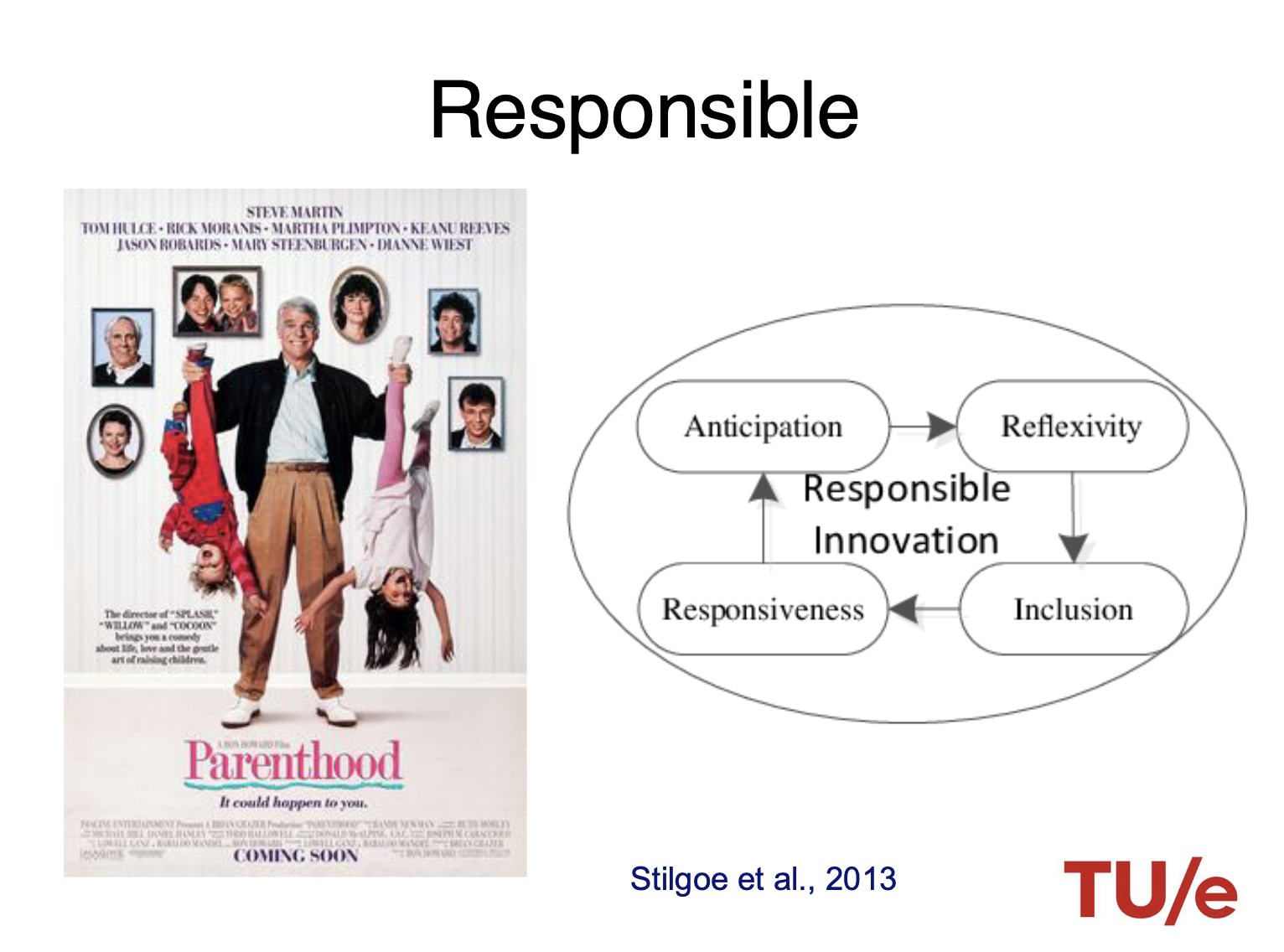
Responsible innovation