(W6) - When Does Unequal become Unfair? Judging Claims of Environmental Injustice
(W6) - When Does Unequal become Unfair? Judging Claims of Environmental Injustice
The author distinguishes 3 layers to justice:
- Legal rights: How people are treated
- Distributive Justice: How benefits and burdens are decided upon
- Procedural Justice: How the distribution is decided upon
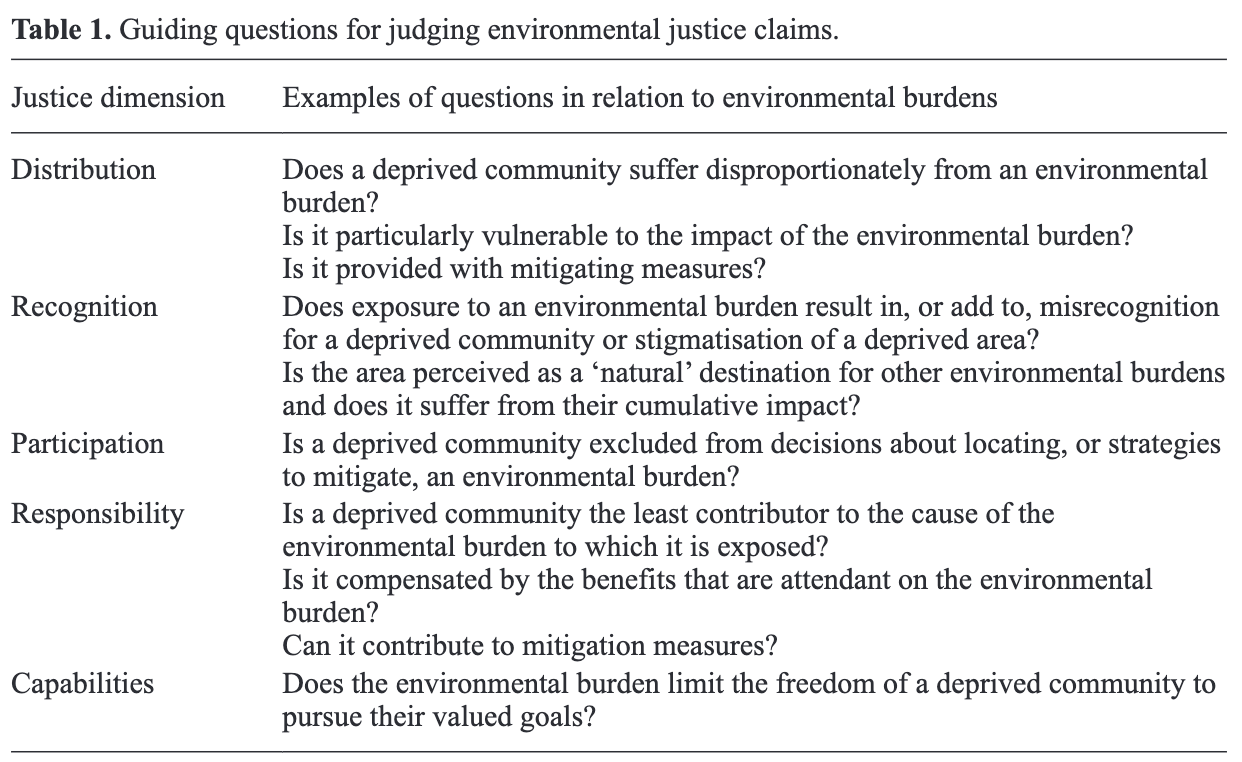
Justice is then analysed under 5 lenses:
- [[#Distribution]]
- [[#Recognition]]
- [[#Participation]]
- [[#Capabilities]]
- [[#Responsability]]
The 5 lenses of justice
Distribution
Who gets what
Most people agree that "a just society is one in which everyone receives a fair share of the available resources", but there is much disagreement on what counts as fair.
3 main theories can be listed:
- Egalitarianism: Equality - everyone should receive the same amount regardless of their input or need
- Libertarianism: Equity - what people receive from society should be based on what they contribute to it
- Utilitarianism: Welfare - what people receive should be based on their needs
Environmental Justice (EJ) has moved beyond pollution and toxic waste to incorporate the distributional patterns of an expansive range of both environmental bads and environmental goods
Recognition
Who counts?
We should not ignore cultural and institutional processes and legacies that have explicitly or implicitly given individuals, communities, or social groups unequal recognition.
Recognition is about equality in differences. It questions how can justice be blind to difference and treat everyone equally while at the same time recognising people's different identities and vulnerabilities.
It's about understanding the differences of those affected by a particular distribution of goods and bads
Participation
Who gets heard?
Justice is not only about sharing resources but also about joining the debate about what that sharing involves an how it should be managed.
See 05 - Participation - STRI.
Capabilities
What matters?
Environmental burdens and benefits have a profound impact on people’s capabilities. They can enable or inhibit their ability to convert other goods to well-being and freedom to function in ways that they have reason to value.
It's about concentrating on actual opportunities rather than the means of living.
On such a basis, justice is not focused on individuals' happiness or pleasure (Utilitarianism) or their income and wealth (resource based approach), but on their freedom and capabilities.
Justice is the capacity of people to function in the lives they choose for themselves.
Capability concerns the equal distribution of the capacities that people need for leading a life of their own design.
Interesting questions to ask:
- Does the environmental burden limit or increase the freedom of people to pursue their valued goals?
- What do the costs, benefits, and risks mean for different stakeholders?
- Are affected people or communities particularly vulnerable for the impacts of (environmental) burdens?
- Can the end-users bear risk? Do they want to?
- Under which conditions could the distribution be acceptable (trade-offs, performance requirements, etc.)?
Responsibility
Who does what?
Obligations and responsibilities are central to any account of justice because being subjected to the harms in which we have had no choice or responsibility reinforces people's sense of injustice.
In environmental justice, we have to raise the issue of not only identifying responsibility towards humans, but also nonhuman nature. There is little attention to the latter, as usually the literature tends to have an anthropocentric view of the world.
We can distinguish instrumental (nature for human's sake) and moral (nature for nature's sake) reasons for taking responsibility for the environment.
Summary