07 - Sustainable Entrepreneurship - STRI
07 - Sustainable Entrepreneurship - STRI
Slides: [[L7 - Sustainable entrepreneurship - Slides - STRI 1.pdf]]
Home readings
- (W7) Conscience as a Mindset - Personal and Organizational - K. Goodpaster
- (W7) Morality and the Invisible Hand - C. McMahon
Lecture
Justice seen as a Social Contract Theory
Individuals jointly agree on the rules of society
Western Individualism:
Politics and business ethics
- In politics most important thing is power: competition is on power
- In economics most important thing is wealth: competition is on wealth
Introduction
Values
It emerges initially in the context of businesses. It then is imported into ethics.
Things people feel should be strived for in general to be able to lead a good life or make a good society.
Ethics vs morality
- Morality: set of rules people follow that enables us to live together
- Ethics: systematic and critical reflection on morals and morality
- theories that try to give you ideal ways of judging
Ethics vs law
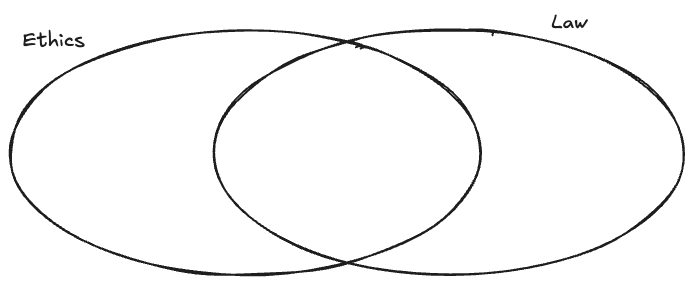
The intersection is the The law that includes set of morality that we want to enforce.
Cheating is immoral but not illegal
There are things that are legal but immoral.
Business ethics
The study of all moral problems associated with free enterprise or, more broadly, market systems
Companies are treated as persons:
- Accountability
- Goals, system of believes
- They can make decisions
In some things they are not persons:
- They don't have an individual mind
Most important part of business ethics is accountability.
- Casual contribution
- Foreseeability
- Freedom of action
Corporations can have a set of values.
Moral development of companies
Goodpaster
What makes a person moral?
- Moral consciousness
- The values you hold
Ghoughtfulness (awareness, conscience) vs thoughlessness
Hannah Arendt on Adolf Eichmann: A life without thinking is quite possible – but it is not fully alive. Unthinking men are like sleepwalkers”
The Milgram experiment
How people react to authority when they are told to do something that is immoral.
https://www.youtube.com/watch?v=xOYLCy5PVgM
Conscience starts with thinking for yourself
Polarity 1: the self vs the other
Conscience develops from the golden rule: "one should treat others as one would like others to treat oneself"
Polarity 2: the self vs the many
Universal identification
vs
Impartial Generalisation
Polarity 3: the ideal vs the real
On a personal level
vs
On a company level
Summary of Goodpaster
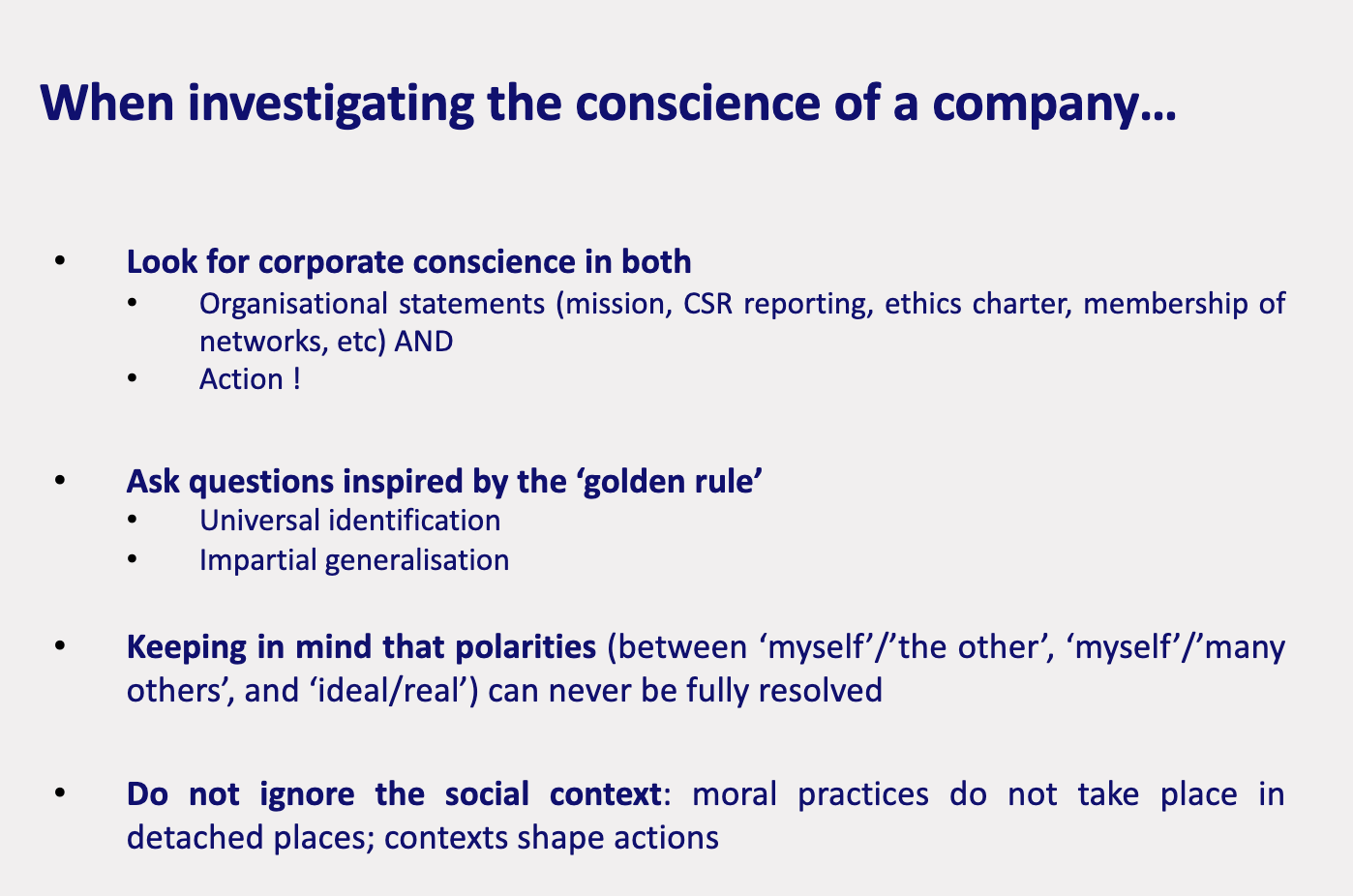
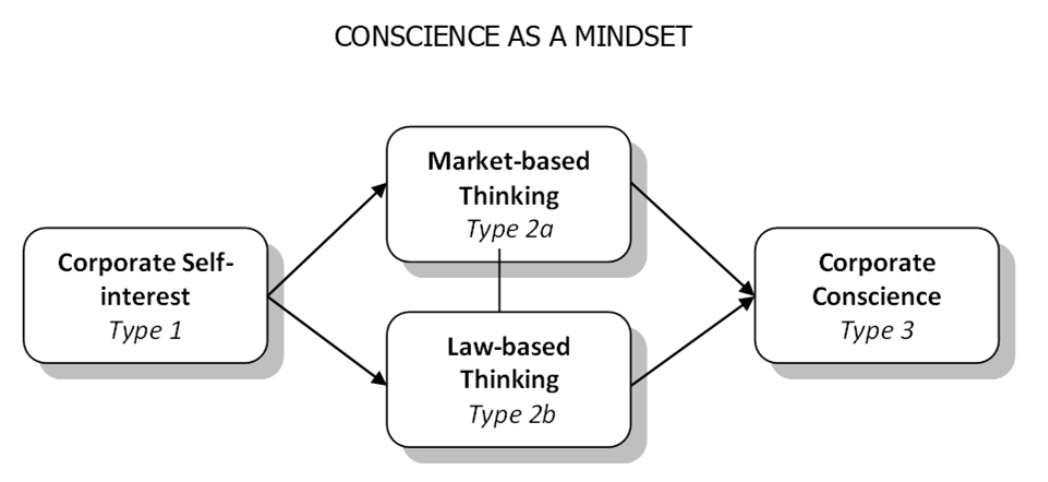
Typology
- Type1: conscience as a guide to self-interest
- Type 2: conscience as a systemic variant
- Type 3: conscience a s an authorative guide
Took this theory from Jean Piaget theory.
He did a lot of research on how children develop moralitu.
- Stage of egoism
- A baby doesn't do anything because it has do finish to develop
- Stage of Moral Realism
- Stage of Autonomy
Kohlberg's stage of moral development
Level 1 - pre-conventional
- Obedience and punishment orientation (how can I avoid punishment?)
- Self-interest orientation (what's in it for me?)
critics: You are doing the right thing for the wrong reason. Not because it's good, just because you want to avoid consequences.
Game theory:
- Optimistic interpretation: it explains how cooperation works but we are all egoist/selfish. We cooperate because it's in our interest
- Pessimistic: Cooperation will always prevail
Level 2 - conventional
- Interpersonal accord and conformity (social norms) (good boy/girl attitude)
- Authority and social-order maintaining orientation (law and order morality)
Level 3 - Post conventional
- Social contract orientation
- Universal ethical principles (principled conscience)
Type 1 - Conscience as self-interest
May be a better idea to do something illegal if the counsequences are smaller than the cost of fixing it, doing the legal thing.
Type 2 - Conscience as systemic constraint
Type 2a - invisible hand
Implicit rules of the market.
Adam Smith: maximise self interest will also bring social good.
Why are we so rich yet there is so much poverty after industrial revolution.
Mismatch between economic growth of production and exponential growth of society.
Type 2b - visible hand
Focus not only on market, but also on laws. Deal with externalities of the market (ex: pollution)
Type 3 - Conscience as self-interest
Goes beyond the invisible hand by adopting an altruistic motive as a moral requirement.
Do things that maybe is not economically positive but you do it for moral reasons.
"Going beyond the market or the law" in not easy:
- Principle of mutual aid could result in inability to close down inefficient producers
- Principle of non maleficence could result in the obligation to install expensive environmentally friendly technologies
- Respect for the (Kantian) principle of autonomy could result in production inefficiencies
Assess a company moral's behaviour
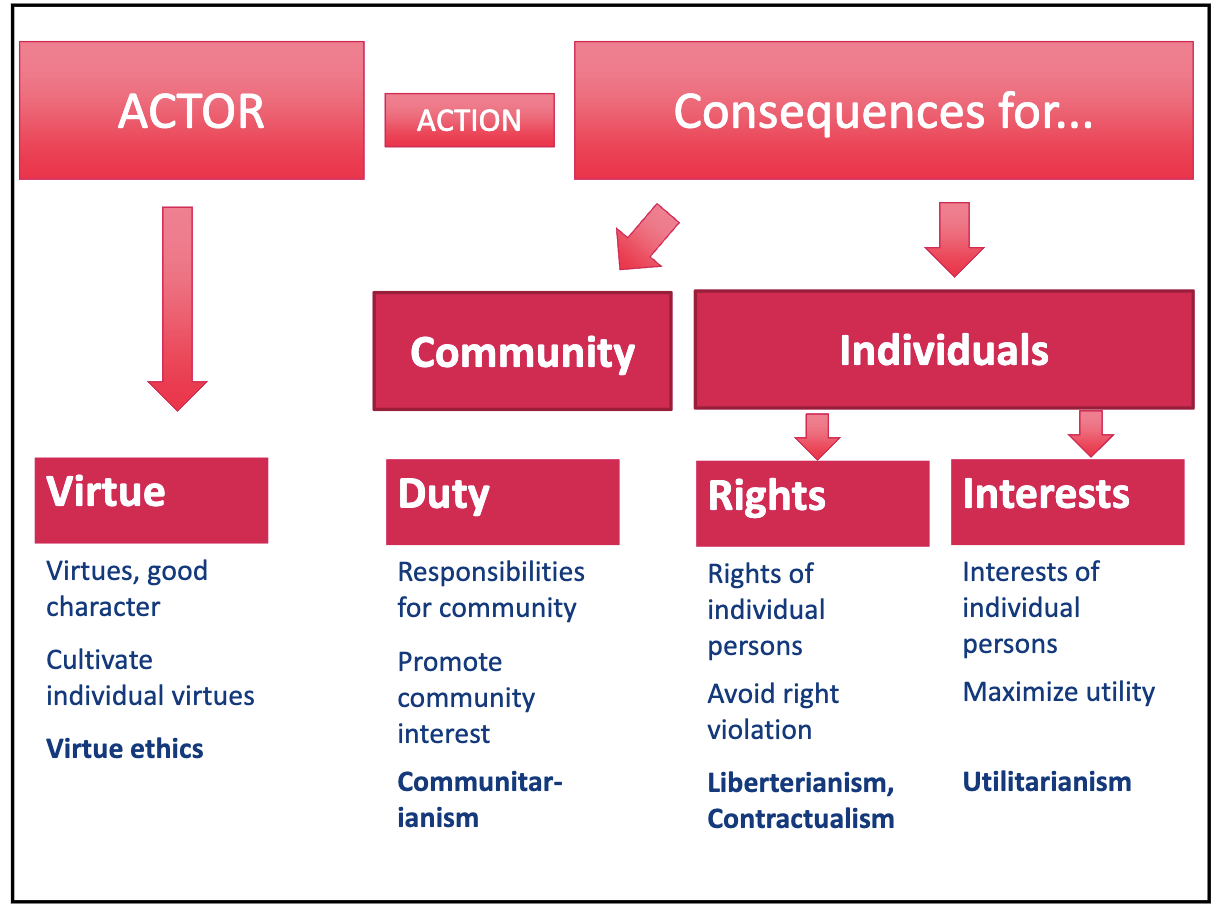
Ethics has to do with coordinating our actions.
Usually 3 theories:
- Person: Virtue ethics: to do good, you need to be a good person. What are the traits that make you a good person
- Action: Deontology: a good action is one that you want everyone to follow
- Consequences: Outcome based (consequentialism < utilitarism)
Goodgasper adds a fourth one: community
4 theories
- Interest based
Interest based
Go with the outcome that does the greatest good: greatest good of the greatest number
Happiness isn't measurable. Maybe do cost benefit analysis (transform everything into monetary terms).
Consequentialism: greatest happiness of the greatest number
Some of the problems:
- Doesn't talk about distribution
- How to account for future generations?
- in C/B analysis we use discount rate: account less for future generations (otherwise it's too skewed to the future)
Rights based
Maximise the protection of the rights of individuals.
Here equal distribution is the most important thing: Equalise right protection
Problems:
- Can become overly paternalistic and overprotective
Duty based
This is the one that Goodpaster adds compare tot he 3 basics theories of ethics
Immanuel Kant is seen as the duty ethics guy.
In this context is duty towards your community.
Problems:
- Groups rights versus individual rights: individuals might get swallowed by a kind of collective
- Conflicting duties and divided loyalties, e.g. workplace <> family
Virtue based
“An ethical theory that focuses on the nature of the acting person. This theory indicates which good or desirable characteristics people should have or develop to be moral” (van de Poel & Royakkers, 2011, p. 95)
Probkems:
- What are the character traits of a good business leader?